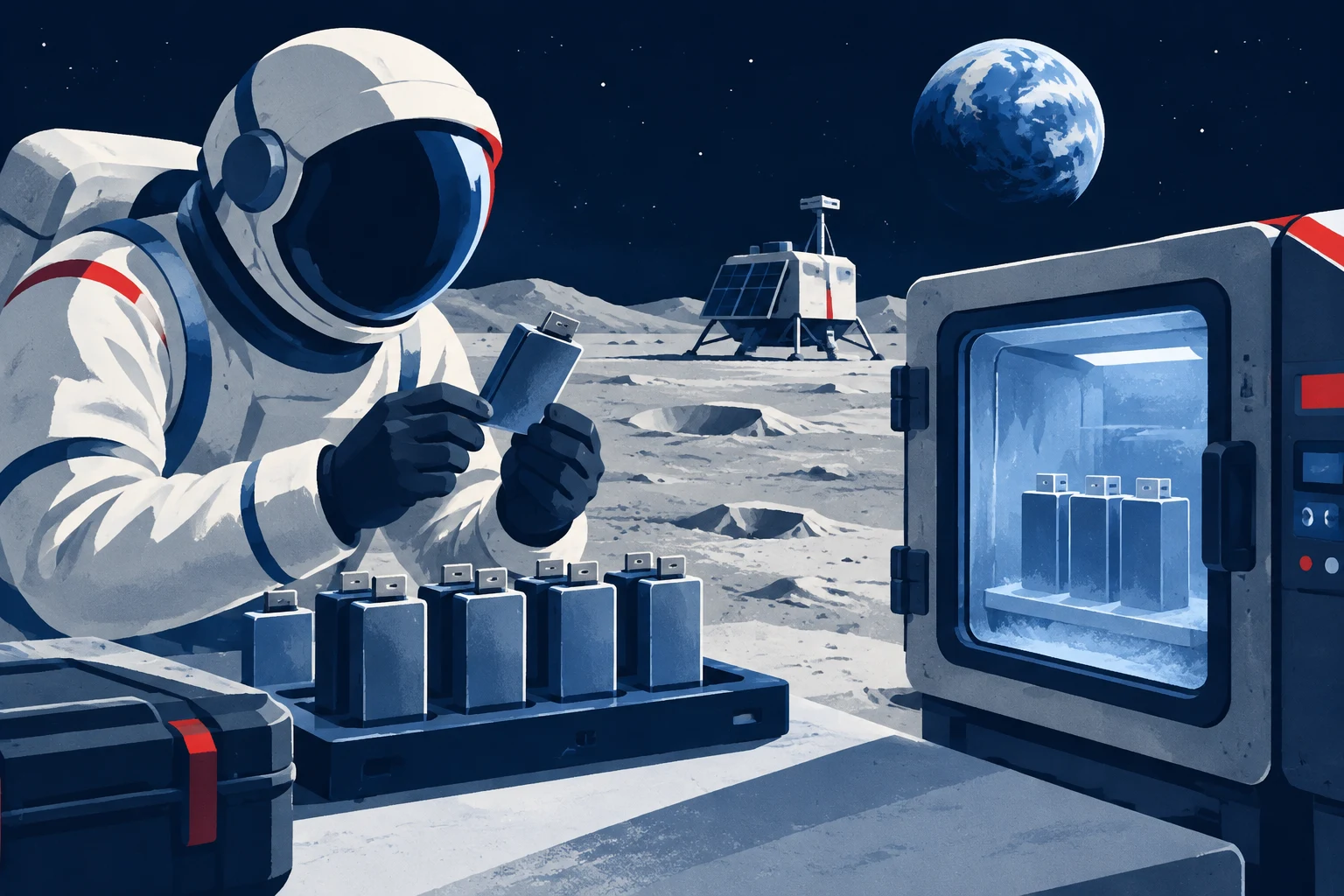
NASA researchers are developing solid-state batteries intended to withstand the harsh temperature swings of the lunar environment, the agency said in an Oct. 14, 2026, report. The project, called SPEARS, is aimed at supporting future Moon operations, including tools, rovers and emergency power supplies.
The batteries replace the liquid electrolyte used in conventional lithium-ion cells with a solid ceramic- or polymer-based material. NASA says that design could avoid problems associated with liquid electrolytes freezing, overheating or evaporating in a vacuum.
In thermal-vacuum tests at NASA’s Langley Research Center, prototype cells operated at temperatures up to 176 degrees Fahrenheit (80 Celsius) and down to minus 76 Fahrenheit (minus 60 Celsius). Performance was somewhat reduced at minus 112 Fahrenheit (minus 80 Celsius), according to the agency. NASA researchers also reported that the cells sustained no damage after exposure to temperatures ranging from 212 Fahrenheit (100 Celsius) to minus 274 Fahrenheit (minus 170 Celsius).
The cells would not operate at the most extreme cold without first being warmed. NASA says small heaters could bring them back to operating temperature after exposure, potentially reducing the need to keep batteries continuously warm. The prototypes have not been described as ready for lunar deployment.
NASA Glenn Research Center leads SPEARS, with Langley conducting testing and Ames developing hardware and electronics intended to help prepare the technology for spaceflight testing. The agency says the project began in 2026 and will initially focus on technology development, with commercial collaboration a possible later step. Researchers also see potential uses beyond space, including portable power applications, though those uses remain prospective.