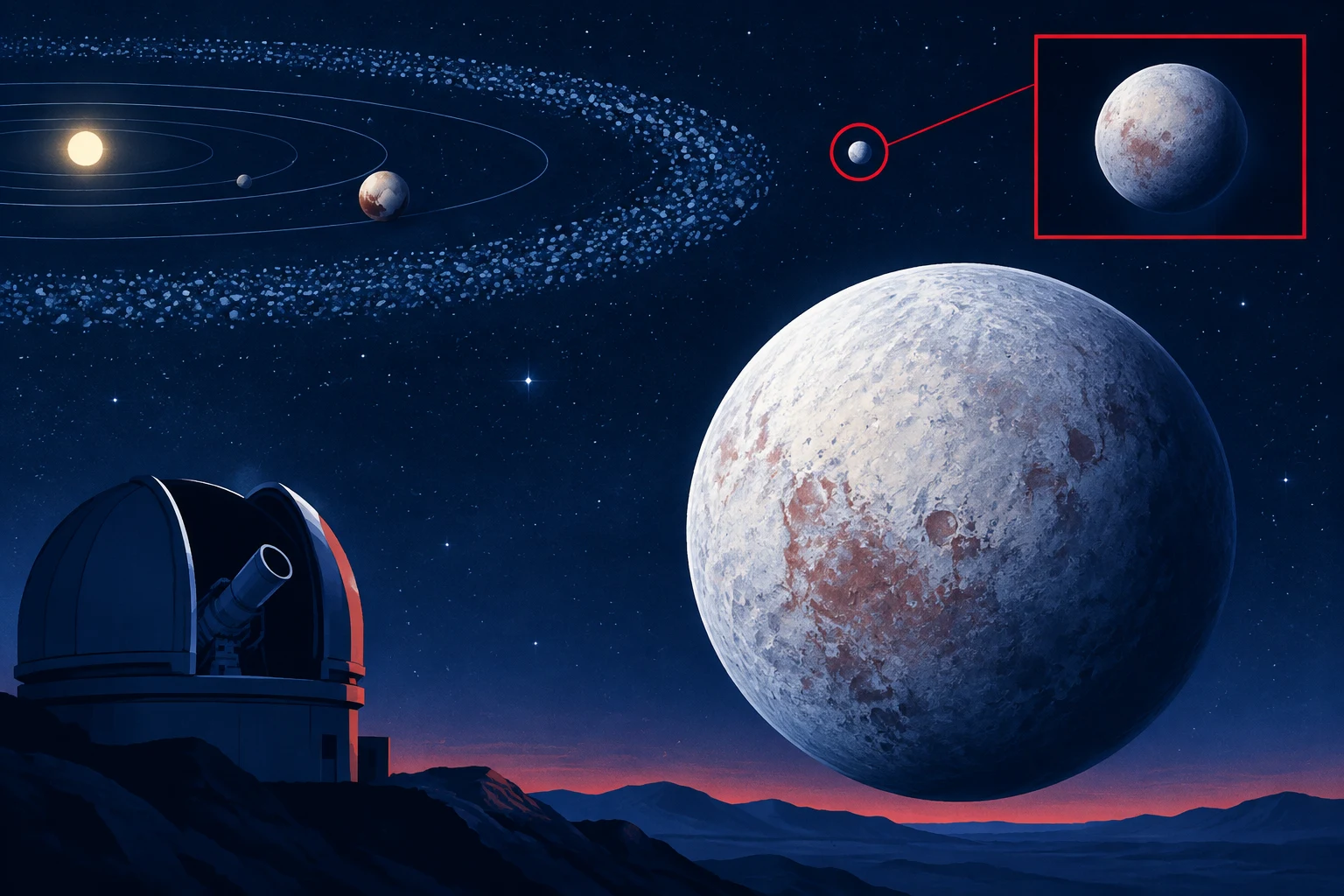
Astronomers have identified a large object beyond Pluto in observations from the Vera C. Rubin Observatory, though its classification as a dwarf planet remains unconfirmed. The object, designated 2026 ED138, is estimated to be between 370 and 930 miles in diameter, according to the observatory’s announcement on Oct. 27.
The discovery came from data collected earlier in 2026. On Oct. 13, astronomer Matthew Holman used computer software he developed with colleague Kevin Napier to search the telescope observations and found the object. The observatory said its apparent brightness and distance suggested it was unusually large. Holman described his initial reaction as excited disbelief and said he checked whether the software or his analysis might have produced an error, given how rare such objects are.
ED138 is about 4.3 billion miles from the sun, farther out than Pluto, which averages about 3.7 billion miles from the sun. It is classified as a trans-Neptunian object because its orbit lies beyond Neptune. The observatory said that if its status is confirmed, ED138 would rank among the largest dwarf planets found in that part of the solar system.
The object was not identified earlier in part because it lies in a densely populated area of the sky near the Milky Way. The observatory said the field contains millions of stars, complicating efforts to distinguish faint, moving objects from the background. Rubin’s repeated sky observations, combined with algorithms designed to pick out moving points of light from large datasets, helped researchers locate ED138 in that crowded region.
The Rubin Observatory is located in Chile and is jointly funded by the National Science Foundation and the Department of Energy’s Office of Science. It began a planned 10-year sky survey in June 2026, using a large digital camera to search for objects that previous observations may have missed. Holman said the repeated coverage could make other objects in overlooked parts of the sky easier to find.
Researchers plan additional observations to determine ED138’s size more precisely and assess whether it qualifies as a dwarf planet. Under the definition described by the observatory, a dwarf planet orbits the sun and is massive enough to be nearly round, but has not cleared other objects from its orbital neighborhood. Pluto was reclassified from planet to dwarf planet in 2006, after having been considered the solar system’s ninth planet since its discovery in 1930.
The current estimate for ED138 spans a wide range, and the supplied report does not describe the additional observations or provide a final classification. The object should therefore be treated as a candidate rather than a confirmed dwarf planet.